
Play Chicken road 2 Now!
Home → Strategy
Chicken Road 2 Strategy
Approaching Chicken Road 2 sensibly
InOut Games released Chicken Road 2 in 2025 as a distinct crash title that operates without reels or paylines. This structural difference means the gameplay relies entirely on timing a cash-out before the multiplier collapses, rather than waiting for symbol combinations. Players must adapt their strategy to this unique mechanic where every round is a single rising multiplier event. The absence of traditional spinning elements requires a focused approach to managing risk during each ascent.
The theoretical RTP of 95.50% defines the long-term expected return for players engaging with this specific game variant. This figure indicates a house edge of 4.50%, which remains constant regardless of the chosen difficulty level or lane count. Understanding this mathematical baseline helps players set realistic expectations about potential losses over extended playing sessions. The medium volatility suggests that wins may occur with moderate frequency, balancing risk against reward potential.
Chicken Road offers a maximum win potential of x3,608,855 across its four distinct difficulty tiers. The Hardcore mode provides 18 lanes and the highest multiplier ceiling, while Easy mode features 30 lanes with a lower cap of x23.24. These variations allow players to select a risk profile that matches their personal tolerance for variance. Choosing a higher difficulty increases the potential payout but significantly reduces the probability of successful cash-outs.
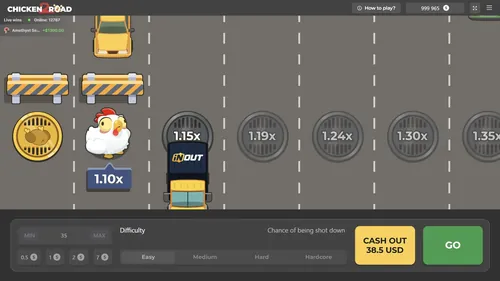
Bankroll rules that hold up
A defined bankroll represents the total capital allocated specifically for playing Chicken Road 2, separate from personal finances. This fund must cover at least several hundred rounds to withstand the inherent variance of a medium volatility crash game. Setting aside a fixed amount prevents emotional decision-making when encountering losing streaks during gameplay sessions. Proper allocation ensures that financial limits are respected regardless of short-term performance fluctuations.
The minimum bet of $0.01 allows for extensive session longevity even with modest initial deposits. Conversely, the maximum stake of $200 per round requires substantial capital to sustain multiple attempts at high multipliers. Calculating the number of possible rounds based on the bankroll size helps determine sustainable play duration. For instance, a $100 bankroll supports ten thousand rounds at the lowest stake level.
Flat betting maintains consistent risk exposure by wagering the same amount during every single round played. Progressive staking strategies increase bets after losses, which accelerates bankroll depletion without altering the built-in house edge. Mathematical analysis shows that raising stakes only shortens the time until ruin occurs in negative expectation games. Maintaining a flat stake preserves the bankroll longer, allowing more opportunities to hit favorable multiplier outcomes.
Bet sizing against volatility
Medium volatility in Chicken Road 2 implies a balanced distribution of win frequencies and payout sizes compared to other crash games. This characteristic means players will experience neither extremely rare large wins nor frequent small payouts exclusively. Adjusting bet sizes relative to bankroll percentage helps manage exposure during volatile periods of multiplier ascents. A standard recommendation is risking no more than one percent of the total bankroll per single round.
In comparison, the original Chicken Road title shares the same developer InOut Games but carries an RTP of 98.00%. This higher theoretical return contrasts with Chicken Road 2's 95.50%, indicating different risk-return profiles between the two titles. Players comparing these games should note that the newer version offers larger maximum win potentials despite the lower RTP. Understanding these differences aids in selecting the appropriate game for specific strategic objectives.
Auto mode functionality allows players to preset cash-out thresholds, removing emotional interference from the decision process. This feature is particularly useful for implementing disciplined bet sizing strategies across hundreds of consecutive rounds. By automating exits, players can strictly adhere to predetermined profit targets or stop-loss limits without hesitation. Automated execution ensures consistency in applying mathematical principles to the unpredictable nature of crash multipliers.
Session limits worth setting
Establishing a time limit for each Chicken Road 2 session helps prevent fatigue-induced errors during critical cash-out moments. Mental exhaustion often leads to delayed reactions when the multiplier reaches significant heights like x100 or beyond. Setting a strict duration ensures that players maintain peak focus throughout their entire gaming period. Consistent breaks between sessions help reset cognitive function and preserve decision-making capabilities for future plays.
The provably fair system used by InOut Games allows verification of each round's outcome using cryptographic methods. This transparency ensures that results are not manipulated, providing confidence in the fairness of the multiplier progression. Players can independently verify that the crash point was determined before their bet was placed. This technical feature adds a layer of trust essential for responsible gambling practices in online environments.
Losing limits prevent excessive financial damage by stopping play once a predefined loss threshold is reached. For example, ceasing activity after losing fifty percent of the allocated bankroll protects remaining funds from further erosion. This discipline counters the psychological urge to chase losses through increasingly aggressive betting patterns. Adhering to pre-set limits maintains financial stability and promotes a healthier relationship with online gaming activities.
Why chasing losses fails
Chasing losses involves increasing bet sizes after defeats to recover previous money, which mathematically accelerates bankroll destruction. Each independent round in Chicken Road 2 has the same 4.50% house edge regardless of prior outcomes. No betting system can overcome this negative expectation because the game does not remember previous results. Attempting to recoup losses through progressive staking inevitably leads to rapid depletion of available funds.
The maximum win cap of x3,608,855 represents the absolute upper limit of any single round's payout potential. While attractive, relying on such extreme outcomes to fix earlier deficits ignores the low probability of occurrence. Statistical models show that expecting rare high-multiplier events to compensate for frequent small losses is flawed reasoning. Sustainable play requires accepting losses as part of the normal variance inherent in crash game mechanics.
In contrast to Chicken Road 2, some slot games offer bonus buys or guaranteed free spin triggers that alter volatility dynamics. These features provide different risk structures but do not apply to the instant resolution nature of crash titles. Players accustomed to slots may find the lack of compensatory mechanisms in chicken road games disorienting initially. Adapting to this format requires embracing uncertainty rather than seeking artificial guarantees through increased wagering.
Chicken Road 2: key facts
| Parameter | Value |
|---|---|
| Game | Chicken Road 2 |
| Studio | InOut Games |
| Released | 2025 |
| RTP | 95.50% |
| House edge | 4.50% |
| Volatility | medium |
| Max win | x3,608,855 |
| Bet range | $0.01 – $200 |
Common systems and their limits
InOut Games designs Chicken Road 2 with a theoretical return of 95.50 percent, establishing a house edge of 4.50 percent over extended play sessions. This mathematical foundation remains constant regardless of the betting pattern employed by the player during each round. Consequently, no strategic adjustment can alter the long-term expected loss inherent in the game structure.
The maximum win potential reaches x3,608,855 across four distinct difficulty levels, offering varying risk profiles for mobile users. Easy mode provides up to x23.24 returns, while Hardcore mode allows for the highest multiplier ceiling available in the title. Players must cash out before the chicken is hit to secure these winnings within the crash mechanic framework.
Fish Road from InOut Games offers a slightly higher RTP of 96.00 percent compared to the 95.50 percent here. This difference highlights how studio titles vary in theoretical return even when sharing similar mechanical foundations. Mobile players should recognize that system limitations are dictated by these fixed mathematical parameters rather than strategy.
Flat betting explained
Flat betting involves wagering the same stake every round, ranging from $0.01 to $200 per bet on the mobile interface. This consistent approach prevents rapid bankroll depletion during losing streaks common in high-volatility crash games like this one. The method relies on maintaining a stable exposure level throughout the gaming session without emotional escalation.
With a medium volatility rating, outcomes fluctuate moderately between small wins and larger multipliers up to x62,162 on Hard mode. Consistent staking allows players to absorb variance more effectively than aggressive progression systems might permit during dry spells. This stability helps preserve the initial bankroll allocated specifically for playing this particular instant game variant.
Auto mode facilitates flat betting execution by automatically placing identical wagers without manual intervention for each new round. This feature reduces human error and maintains discipline when navigating the forty lanes or fewer depending on selected difficulty. Players focusing on longevity will find this automated consistency aligns well with responsible bankroll management principles.
Progressive staking risks
Progressive staking raises stakes after losses, which does not change the built-in edge and only shortens the time to ruin. Raising bets to recover previous deficits ignores the independent nature of each crash event in Chicken Road 2. The house edge of 4.50 percent applies equally to increased wagers as it does to minimum bets placed initially.
The maximum win cap of x3,608,855 cannot be reached faster by increasing bet sizes due to the linear multiplier growth. Attempting to chase losses through larger wagers exposes the entire bankroll to rapid erosion during consecutive failures. Mathematical reality dictates that no betting system alters the fundamental probability distribution governed by provably fair algorithms.
Fish Road shares similar progressive risks despite its 96.00 percent RTP offering a marginally better theoretical return profile. Both titles demonstrate that raising stakes after losses merely accelerates bankroll exhaustion rather than improving winning probabilities. Mobile users employing such strategies often deplete funds quickly because the game mechanics do not reward escalating commitments.
What the maths actually allows
RTP stands for Return to Player, defined as a theoretical long-run average over hundreds of thousands of spins, never a forecast for one session. Chicken Road 2 returns 95.50 percent theoretically, meaning 4.50 percent stays with the operator as the house edge. This percentage governs all potential payouts regardless of whether playing Easy mode up to x23.24 or Hardcore modes.
Volatility indicates how frequently and how large wins occur relative to the bet size placed on the mobile device. Medium volatility suggests balanced payout intervals rather than extreme scarcity or excessive frequency found in other variants. Players should expect moderate swings in their bankroll balance while attempting to reach the upper multiplier thresholds available.
Provably fair technology ensures transparency in the random number generation process determining when the chicken gets hit each round. This verification method allows players to confirm that outcomes were not manipulated after their bet was placed on mobile. Such integrity supports the mathematical model where 95.50 percent return is distributed according to predefined probability tables.
Reading variance honestly
Variance measures the dispersion of results around the mean return of 95.50 percent over a significant sample size. High variance scenarios occur when hitting multipliers near the maximum win cap of x3,608,855 on Hardcore difficulty settings. Understanding this spread helps manage expectations regarding short-term performance versus the long-term statistical average provided by the studio.
Easy mode with thirty lanes yields lower variance compared to Hardcore mode with eighteen lanes offering much higher potential swings. Smaller multipliers up to x23.24 appear more frequently, providing steadier but less dramatic fluctuations in account balances. Players choosing lower difficulties experience smoother equity curves aligned with the medium volatility classification assigned to the game.
InOut Games structures these variance profiles to accommodate different risk appetites among its global mobile user base. Fish Road demonstrates comparable variance characteristics despite differing RTP values, showing how design choices impact gameplay dynamics. Honest reading requires acknowledging that luck drives short-term results while mathematics dictates long-term financial outcomes for all participants.
Learning the game in demo first
Chicken Road 2 by InOut Games operates as a crash title without reels or paylines, requiring players to cash out before the multiplier ends. The theoretical RTP stands at 95.50%, which establishes a house edge of exactly 4.50% over extended play sessions. Understanding this mathematical framework is essential before risking real funds on any round.
The developer provides four distinct difficulty levels that determine lane counts and maximum multipliers for each session. Easy mode offers thirty lanes with a cap of x23.24, while Hardcore mode restricts players to eighteen lanes but allows wins up to x3,608,855. This structure demands different risk assessments depending on the chosen path.
Rabbit Road from the same studio shares identical mechanics and the same 95.50% RTP value, allowing direct comparison of difficulty settings. Players can test their strategy against these parameters without financial loss in the demo environment. This practice helps identify which lane count aligns with personal tolerance for variance.
Adjusting stakes to your budget
The bet range spans from $0.01 to $200 per round, offering flexibility for bankroll management across various budget sizes. A minimum stake of one cent allows for extensive testing of the auto mode features without significant capital exposure. This wide spectrum ensures that both casual players and high rollers find suitable entry points.
Maximum win potential reaches x3,608,855 in the Hardcore tier, creating massive payout possibilities even with modest initial wagers. Betting twenty dollars at this level could theoretically yield over seven hundred million units if the chicken survives all steps. Such outliers require strict discipline to avoid chasing unrealistic returns during normal play.
Progressive staking strategies raise stakes after losses, which does not change the built-in edge and only shortens the time to ruin. Flat betting maintains the same stake every round, preserving the bankroll duration more effectively than aggressive increases. Consistent wagering aligns better with the medium volatility profile of the game.
Recognising a bad session
A session becomes problematic when cumulative losses exceed the predetermined bankroll limits set before opening Chicken Road 2. Since the game has no spins or reels, tracking rounds instead of traditional slot metrics prevents confusion about performance. Monitoring the number of failed cash-outs helps identify deviations from expected statistical outcomes.
The 4.50% house edge means that over hundreds of thousands of rounds, the casino retains this percentage of total wagers. If a player experiences rapid depletion of funds despite using flat betting, the variance may be exceeding typical expectations. Recognizing this pattern early allows for immediate cessation of play to preserve remaining capital.
Comparing current results against Rabbit Road reveals similar volatility characteristics due to the shared 95.50% RTP foundation. Deviations significantly below this return rate indicate unfavorable streaks that rarely correct themselves quickly. Accepting these mathematical realities prevents emotional decision-making during downturns.
Stopping while ahead
Cash out decisions must occur before the chicken is hit, securing profits within the rising multiplier curve of each round. Achieving a win near the x3,608,855 cap represents an exceptional outcome that should trigger immediate withdrawal of winnings. Greed often leads to giving back substantial gains by continuing to play after reaching target goals.
The bonus terms offer a 300% welcome bonus up to €2,000 plus 100 free spins, which can boost initial playing capital. However, wagering requirements attached to such bonuses typically accelerate the pace of play and increase exposure to the house edge. Separating bonus funds from personal deposits helps maintain clear financial boundaries during gameplay.
Setting a specific profit target, such as doubling the initial deposit, provides a concrete exit strategy independent of luck. Once this threshold is reached, closing the session preserves the gain rather than risking it on future rounds. Discipline in stopping while ahead is crucial for long-term sustainability in crash games.
Responsible play in practice
InOut Games includes provably fair technology in Chicken Road 2, allowing players to verify the randomness of each round independently. This transparency ensures that the 95.50% RTP is not manipulated and that outcomes remain truly random and unpredictable. Trust in the system supports responsible engagement without suspicion of unfair practices.
Auto mode features enable setting predefined cash-out points, removing emotional interference from split-second decision making during rapid rounds. This tool helps enforce disciplined strategies by executing trades automatically according to pre-set parameters. Utilizing automation reduces the temptation to deviate from established plans during intense moments.
Time limits and deposit caps are essential tools for maintaining control over gambling habits when accessing platforms like chickenroads2.io. Regular breaks prevent fatigue-induced errors in judgment that could lead to excessive losses beyond the intended scope. Responsible play requires active management of both time and money spent on the platform.
DemoRTP & VolatilityHow to PlayAuto CashoutStrategyBonusesMobileDownload & AppMax WinSimilar GamesReviewFAQSitemap
Chicken road 2 2026