
Play Chicken road 2 Now!
Home → Auto Cashout
Chicken Road 2 Auto Cashout
Auto cashout in Chicken Road 2
The auto cashout feature closes a bet automatically at a chosen multiplier within the InOut Games title Chicken Road 2. This mechanism removes reaction time from the outcome, ensuring that a player secures winnings before the crash occurs. It operates independently of the built-in house edge of 4.50%, which remains constant across all rounds.
Chicken Road 2 round parameters
| Max multiplier | x3,608,855 |
| RTP | 95.50% |
| Bet range | $0.01 - $200 |
Players can set specific thresholds for the rising multiplier to trigger an automatic exit during a round. The system monitors the game state continuously, executing the cash-out instruction precisely when the target is reached. This eliminates the need for manual intervention and reduces the risk of human error during fast-paced gameplay.
Using automation allows for consistent application of betting strategies without emotional interference or hesitation. A player might choose a low multiplier to secure frequent small wins or a higher value for larger payouts. The feature ensures that every pre-defined condition is met strictly according to the user's settings.
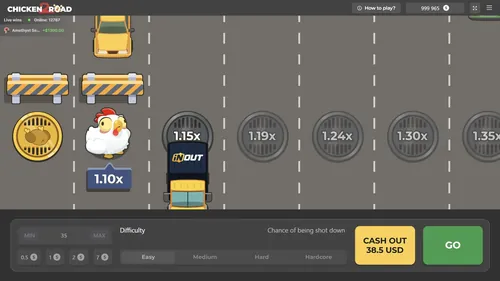
Setting a target multiplier
Chicken Road 2 offers four distinct difficulty levels, each with a different maximum win potential up to x3,608,855. Setting a target multiplier requires understanding the lane structure of the selected level, such as the 30 lanes in Easy mode or the 18 lanes in Hardcore mode. The choice directly influences the probability of reaching the desired payout before the chicken is hit.
In the Medium difficulty setting, the maximum possible win reaches x2,457, providing a moderate risk-reward profile. Players aiming for this ceiling must adjust their target multiplier accordingly, balancing between safety and profit. The theoretical RTP of 95.50% applies across these variations, dictating the long-term expected return on wagers.
Targeting the highest multiplier in Hardcore mode involves navigating only 18 lanes, significantly increasing the crash frequency. A player setting a target near x3,608,855 accepts a much lower probability of success compared to targeting x23.24 in Easy mode. Each level requires a separate strategic decision regarding how high the multiplier should rise before auto-cashing out.
Why automation removes hesitation
Hesitation often leads to missed opportunities in crash games where the multiplier rises rapidly towards a random end point. Auto cashout eliminates the split-second delay caused by human reaction times, securing the exact target value every time. This precision is critical in Chicken Road 2, where the difference between winning and losing can be negligible.
The InOut Games developer designed the game to be provably fair, meaning outcomes are verifiable and not manipulated. Automation complements this fairness by removing subjective decision-making from the execution phase. Players rely on mathematical probabilities rather than instinct, which helps maintain discipline over extended playing sessions.
Without auto cashout, players might chase losses or get greedy, waiting too long for a bigger multiplier until the round crashes. Automated settings enforce a predetermined strategy, preventing emotional deviations from the original plan. This consistency is particularly important given the medium volatility and the substantial max win potential of x3,608,855.
Low targets versus high targets
Choosing a low target multiplier in Chicken Road 2 increases the frequency of successful cash-outs but reduces individual payout sizes. For instance, targeting a low value in Easy mode (up to x23.24) offers more frequent returns compared to chasing high multipliers. This approach aligns with a conservative strategy aimed at preserving bankroll over many rounds.
High targets, such as those approaching the x3,608,855 cap in Hardcore mode, result in fewer successful cash-outs due to the reduced number of lanes. Players accepting this lower probability seek larger single payouts to compensate for the increased risk of loss. The trade-off between hit frequency and win size is inherent to the game's medium volatility design.
Comparing Chicken Road 2 to its predecessor Chicken Road reveals similar mechanics but potentially different player expectations regarding risk. While both titles share the same studio, adjusting target multipliers allows players to tailor their experience to their risk tolerance. Low targets provide steady engagement, whereas high targets offer the thrill of pursuing the maximum win limit.
Auto bet alongside auto cashout
Auto bet functionality allows players to automate the wagering process, placing bets automatically after each round concludes in Chicken Road 2. This feature works in tandem with auto cashout to create a fully hands-free gaming session. Players can set the bet amount within the range of $0.01 to $200 per round, ensuring controlled spending.
Combining auto bet with auto cashout enables continuous play without manual intervention for either placing wagers or securing profits. This integration is useful for testing strategies over hundreds of rounds while maintaining the theoretical RTP of 95.50%. The system executes each step sequentially, reducing the chance of operational errors during rapid gameplay.
Using both features simultaneously requires careful configuration to ensure alignment with the player's financial limits and risk appetite. Adjusting the auto bet amount allows for stake management strategies, such as flat betting or progressive adjustments. This combination enhances efficiency, allowing players to focus on strategy rather than repetitive manual actions.
Chicken Road 2: key facts
| Parameter | Value |
|---|---|
| Game | Chicken Road 2 |
| Studio | InOut Games |
| Released | 2025 |
| RTP | 95.50% |
| House edge | 4.50% |
| Volatility | medium |
| Max win | x3,608,855 |
| Bet range | $0.01 – $200 |
Choosing a cashout target
InOut Games structures Chicken Road 2 with four distinct difficulty levels that dictate the lane count and potential multiplier range for every single round played by the user. The Easy mode offers thirty lanes with a maximum win of x23.24, while the Hardcore variant reduces the path to eighteen lanes but allows for a massive payout up to x3,608,855. Players must select their preferred risk tier before placing a wager, as this choice permanently defines the volatility profile of the session.
The theoretical return to player is fixed at 95.50% across all modes, meaning the house retains a 4.50% edge regardless of whether one chooses the low-risk Easy setting or the high-stakes Hardcore option. This mathematical constant ensures that long-term expectations remain stable, even though short-term variance differs significantly between the thirty-lane and eighteen-lane configurations available to the gambler. Understanding this baseline helps users manage their bankroll more effectively when targeting specific multipliers during gameplay.
Around the clock mobile accessibility allows players to adjust these targets instantly without loading screens, ensuring that the chosen difficulty level remains consistent across different devices. InOut Games designed the interface so that switching from Medium to Hard mode takes mere seconds, allowing for rapid adaptation to changing financial conditions. This flexibility supports responsible gaming habits by enabling users to lower their stakes immediately after a series of unsuccessful attempts on higher tiers.
Frequency against payout size
Chicken Road 2 operates as a medium volatility crash game where the frequency of smaller wins contrasts sharply with the rarity of hitting the maximum win cap of x3,608,855. The Hardcore mode presents only eighteen possible paths, making high multipliers less frequent but substantially more lucrative compared to the thirty lanes found in the Easy difficulty setting. This inverse relationship between probability and reward size is central to the strategic depth required for successful mobile play sessions.
In contrast, Fish Road from the same developer offers a slightly higher RTP of 96.00% with a max win of x2,542,251.93, providing a different risk-reward balance for comparison. While Fish Road focuses on a similar mechanic, Chicken Road 2 pushes the upper limit higher through its reduced lane count in harder modes, creating steeper peaks in potential earnings. Users analyzing these titles should note that the 4.50% house edge in Chicken Road 2 is slightly higher than the 4.00% edge in Fish Road.
The bet range spans from $0.01 to $200, allowing micro-betting strategies to mitigate the impact of frequent losses in the high-difficulty modes. A player wagering $200 per round in Hardcore mode faces significant variance, as a single loss wipes out twenty thousand units of minimum bets. This wide betting spectrum ensures that both casual mobile users and high rollers can participate, though the statistical expectation always favors the house over extended periods.
Testing targets in demo
Playing Chicken Road 2 in demo mode allows users to experiment with the auto cashout feature without risking real funds, helping them understand how reaction time impacts results. The auto cashout closes a bet automatically at a chosen multiplier, removing human hesitation from the equation and stabilizing outcomes based purely on the game's provably fair algorithm. This tool is particularly useful for testing how quickly the chicken crosses the road in the eighteen-lane Hardcore mode versus the thirty-lane Easy version.
InOut Games ensures that the demo environment mirrors the real-money experience exactly, including the 95.50% RTP and the full range of difficulty settings available in the live game. Users can verify that the provably fair system generates identical sequences in both modes, confirming that no hidden mechanics alter the expected value during practice sessions. This transparency builds trust, as players know that the statistics they observe in free play will hold true when they transition to using real currency.
The absence of financial pressure in demo mode enables players to calculate optimal cashout points for each of the four difficulty levels without emotional interference. By running hundreds of simulated rounds, one can determine that targeting x2.00 in Easy mode yields a higher hit rate than chasing x100.00 in Hardcore mode. These insights are crucial for developing a sustainable strategy before committing any of the allowed bet limits ranging from $0.01 to $200.
Adjusting after a losing streak
When facing a losing streak in Chicken Road 2, moving from the Hardcore mode back to the Easy mode reduces exposure by increasing the number of safe lanes from eighteen to thirty. This strategic shift lowers the immediate probability of a crash while maintaining access to the same 95.50% theoretical return over the long term. Players often use this adjustment to recover small losses gradually rather than attempting to chase big wins with larger bets in high-volatility settings.
The maximum win potential of x3,608,855 remains achievable only in the Hardcore mode, but reaching it requires enduring longer periods of negative variance due to the reduced lane count. In contrast, the Easy mode caps at x23.24, offering frequent but smaller payouts that help stabilize a depleted bankroll during difficult sessions. Understanding this trade-off allows users to make informed decisions about when to switch difficulties based on their current financial standing.
InOut Games provides an auto mode that can be configured to stop playing after a set number of losses, preventing impulsive behavior during downswings. This safety feature works alongside the provably fair system to ensure that outcomes remain random and independent of previous rounds. By setting strict loss limits within the auto mode, players can protect their funds while still engaging with the medium volatility mechanics that define the game.
When to turn automation off
Turning off the auto cashout feature is advisable when playing Chicken Road 2 in Hardcore mode, as the eighteen-lane structure demands quick manual reactions to avoid sudden crashes. Automation removes the element of human judgment, which may lead to missed opportunities if the multiplier rises faster than the preset threshold in high-difficulty settings. Players who prefer active engagement often disable this function to maintain control over their exit points during volatile rounds.
The bet range of $0.01 to $200 allows for flexible stake adjustments, but relying solely on automation can obscure the actual pace of the game. Manual play enables users to observe patterns in the provably fair sequence and adjust their wagers accordingly, potentially capitalizing on perceived trends despite the random nature of the outcome. This hands-on approach contrasts with the passive experience offered by fully automated sessions in the easier difficulty levels.
Comparing Chicken Road 2 to Fish Road highlights that both games support automation, but the higher max win of x3,608,855 in Chicken Road 2 creates greater tension during manual play. The 4.50% house edge remains constant, yet the psychological impact of waiting for a high multiplier in Hardcore mode is more intense than in lower-risk scenarios. Disabling automation allows players to savor these moments, enhancing the overall entertainment value of the mobile gaming experience.
Double bet setups
The minimum wager of $0.01 allows players to construct two parallel bets totaling $0.02 without exceeding the table limits. This approach splits the risk across two independent rounds within the same difficulty tier, such as Easy mode which offers up to x23.24 multipliers. The player maintains control over both outcomes simultaneously, effectively doubling the frequency of game interactions per unit of time spent at the keyboard.
Increasing the base stake to $1.00 per line creates a combined exposure of $2.00 for each round cycle in Chicken Road 2. This setup utilizes the full range of the medium volatility profile defined by InOut Games while keeping the total session bankroll manageable for longer play sessions. The theoretical return remains fixed at 95.50%, ensuring that the mathematical expectation does not change regardless of how the capital is distributed across the two active lines.
Scaling the investment to the maximum limit of $200 per side requires a total balance of $400 to sustain a single simultaneous round pair. This high-stakes configuration targets the Hardcore level where potential payouts reach x3,608,855, demanding precise timing for cashing out before the crash occurs. Such aggressive betting strategies amplify both the potential reward and the immediate financial loss, testing the discipline required to adhere to strict stop-loss parameters during volatile market swings.
Splitting stakes across two bets
Utilizing the auto cashout feature enables a player to secure profits on one bet while letting another run toward higher multipliers in Chicken Road 2. For instance, setting an automatic exit at x2.00 locks in half the potential gain from the Easy mode lane immediately after the start. This technique removes emotional hesitation from the decision-making process, allowing the second bet to pursue the higher risk-reward ratio available in the Hard or Hardcore difficulty settings.
The house edge of 4.50% applies uniformly to each individual wager placed on the platform, meaning splitting stakes does not alter the underlying mathematical disadvantage. A player might allocate $10 to a conservative target and $10 to an aggressive target, creating a diversified portfolio of instant game outcomes. This method spreads variance across different multiplier thresholds, smoothing out the equity curve compared to placing the entire $20 on a single high-variance outcome.
InOut Games designs the provably fair algorithm to ensure that each lane operates independently, allowing true statistical separation between the two concurrent bets. By monitoring the rising multiplier curve separately for each ticket, the analyst can identify optimal exit points based on real-time data rather than guesswork. This granular control over execution timing is critical when managing multiple open positions within the same round structure.
Combining a safe and a risky target
A balanced strategy pairs a low multiplier cashout with a high-risk hold, leveraging the specific lane counts of Medium mode which features 25 distinct paths. Securing a win at x1.50 covers the initial stake cost, while the remaining position chases the upper limit of x2,457 available in this tier. This hybrid approach stabilizes the bankroll against rapid depletion during losing streaks while still providing exposure to significant payout events.
Comparing this method to Rabbit Road reveals similar structural mechanics but different risk profiles, as both titles share the same developer and max win cap of x3,608,855. However, Chicken Road 2 allows explicit selection of difficulty levels, enabling players to adjust the probability density of crashes directly. This flexibility permits a more tailored risk management plan compared to games with fixed volatility settings.
The maximum win potential of x3,608,855 represents the absolute ceiling for any single successful round in the Hardcore category with only 18 lanes. Combining this with a safe bet ensures that even if the high-risk position fails, the overall session result remains positive or break-even. This dual-target system effectively hedges against the inherent randomness of the crash point determination.
Limits of any automated plan
Auto-mode functions strictly as a tool for executing pre-defined orders and cannot predict the random crash point generated by the provably fair system. Setting a cashout at x10.00 guarantees execution only if the multiplier reaches that threshold, but it offers no protection against earlier termination of the round. The built-in 4.50% house edge persists regardless of automation speed, meaning long-term profitability remains statistically impossible under any configured parameter.
The bet range spans from $0.01 to $200, imposing hard constraints on the scalability of any automated betting progression system. Martingale strategies fail because the maximum bet limit prevents recovery after consecutive losses exceed the bankroll capacity or table limits. Players must recognize that automation simplifies trade execution but does not enhance the fundamental odds provided by InOut Games.
Rabbit Road shares identical technical specifications regarding max wins and RTP, yet lacks the explicit difficulty tier selection present in Chicken Road 2. This distinction means automated plans for Rabbit Road must rely on uniform probability distributions, whereas Chicken Road 2 allows varying volatility through lane count adjustments. Analysts note that this variability complicates the development of universal automation scripts.
What automation cannot fix
No software algorithm can overcome the negative expected value dictated by the 95.50% return-to-player rate over extended play sessions. Even with perfect timing on auto-cashouts, the cumulative losses will align with the 4.50% house edge as the number of rounds increases. This mathematical reality holds true whether the player manually clicks the button or delegates the action to a script running in the background.
The volatility classification of medium indicates moderate fluctuation in results, requiring substantial bankroll reserves to survive downswings without hitting the table limits. Automated systems often encourage faster betting frequencies, which accelerates the realization of the theoretical loss rate defined by the studio. Players should monitor their session duration closely to prevent impulsive behavior driven by false confidence in predictive tools.
Bonus terms offering a 300% welcome bonus up to €2,000 introduce additional wagering requirements that complicate automated profit extraction strategies. Withdrawal restrictions and turnover conditions must be calculated into the automation logic to ensure compliance with casino rules set by the operator. Failure to account for these external constraints can lead to blocked accounts despite successful game outcomes.
DemoRTP & VolatilityHow to PlayAuto CashoutStrategyBonusesMobileDownload & AppMax WinSimilar GamesReviewFAQSitemap
Chicken road 2 2026