
Play Chicken road 2 Now!
Home → Similar Games
Games Similar to Chicken Road 2
Games close to Chicken Road 2
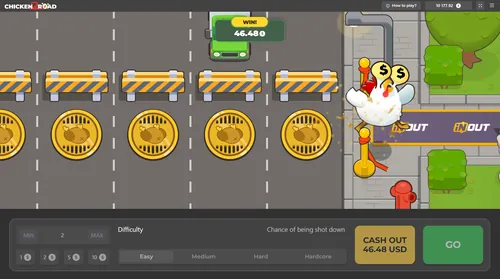
The developer InOut Games released Chicken Road 2 in 2025, establishing a distinct mobile interface for this step-based crash game. This sequel features four difficulty levels that adjust the lane count from thirty down to eighteen, directly impacting the risk profile on handheld screens. Players must cash out before the chicken is hit, ensuring the core mechanic remains intact across different device sizes.
In contrast, the original Chicken Road from InOut Games offers an RTP of 98.00%, which differs significantly from the 95.50% return of its successor. The maximum win potential remains identical at x3,608,855 for both titles, suggesting a consistent mathematical ceiling despite the updated mechanics. Mobile users benefit from this stability, as the payout structure does not change between the first and second versions of the road-crossing concept.
Above these studio releases, Aviator by Spribe presents a different crash experience with an RTP of 97.00% and a max win capped at x1,000,000. This title lacks the lane-based progression found in Chicken Road 2, replacing it with a rising multiplier curve that operates independently of step counts. Mobile players often compare the two formats to determine which risk model suits their preferred betting strategy on smaller displays.
Titles with similar maths
Rabbit Road from InOut Games shares the exact 95.50% RTP and the same maximum win cap of x3,608,855 as Chicken Road 2. These identical figures indicate a synchronized mathematical engine between the two titles, allowing mobile players to switch games without adjusting their expected loss rates. The variance in lane counts may differ, but the long-term theoretical return remains constant across these specific studio offerings.
Fish Road introduces a slightly higher RTP of 96.00% while maintaining a high maximum win of x2,542,251.93, which is lower than the x3,608,855 limit seen elsewhere. This adjustment in the house edge provides a marginally better theoretical outcome for mobile bettors over extended sessions compared to the 95.50% standard. The difference in maximum payout potential also influences bankroll management strategies for players chasing large multipliers on handheld devices.
Mines by an unpublished studio maintains an RTP of 97.00%, offering a safer theoretical return than the 95.50% found in Chicken Road 2. Although the genre overlaps as an instant game, the absence of a published provider means mobile users lack specific developer history for comparison. The higher return figure suggests a lower house edge, which appeals to analytical players seeking optimal mathematical conditions on mobile platforms.
Same studio alternatives
InOut Games developed both Chicken Road 2 and the original Chicken Road, ensuring a consistent user interface across their portfolio of crash titles. The successor retains the provably fair system and auto mode features, which are essential for mobile users managing multiple bets simultaneously. This continuity allows players to transfer their familiarity with the studio's design language when switching between the older and newer releases.
Fish Road represents another alternative from InOut Games, featuring a distinct theme while utilizing the same underlying technical infrastructure as Chicken Road 2. The studio maintains a medium volatility profile across its road-based games, balancing risk and reward for mobile audiences accustomed to quick rounds. The consistent development approach ensures that payment processing and account integration remain seamless regardless of which specific title is selected.
Rabbit Road completes the trio of InOut Games alternatives, mirroring the 95.50% RTP and x3,608,855 max win of Chicken Road 2 precisely. This mathematical identity allows mobile players to treat these games as interchangeable options within the same ecosystem without altering their strategic expectations. The shared developer background guarantees that feature sets like auto-betting and provable fairness operate identically across all three titles.
Comparable volatility
Chicken Road 2 exhibits medium volatility, meaning wins occur with moderate frequency while retaining the potential for significant payouts up to x3,608,855. This balance suits mobile players who prefer steady engagement over the extreme swings associated with high-variance slots or crash games. The medium risk level ensures that bankrolls deplete slowly enough to allow for extended play sessions on devices with limited battery life.
Tower Rush by Galaxsys offers a contrasting volatility profile with a much lower maximum win of 100x, indicating a significantly reduced risk exposure. While Chicken Road 2 allows for massive multipliers through its lane-based progression, Tower Rush caps earnings early, appealing to conservative mobile bettors. The difference in max win potential highlights how volatility shapes the gameplay loop, with Chicken Road 2 favoring high-risk tolerance.
Aviator by Spribe maintains an RTP of 97.00% but lacks a specified volatility rating, making direct comparison with the medium volatility of Chicken Road 2 difficult. However, the max win of x1,000,000 suggests a high-variance structure capable of large payouts, similar to the upper limits of Chicken Road 2. Mobile players must therefore rely on the RTP and max win figures rather than explicit volatility labels to gauge risk intensity.
Comparable return figures
Chicken Road 2 returns 95.50% theoretically, resulting in a house edge of 4.50% over a very long run of rounds. This figure defines the expected loss rate for mobile players, who should anticipate losing 4.50 cents for every dollar wagered statistically. The medium volatility ensures that this edge is realized gradually, preventing rapid bankroll depletion during typical gaming sessions on mobile devices.
Fish Road provides a superior return figure of 96.00%, reducing the house edge to 4.00% compared to the 4.50% of Chicken Road 2. This 0.50% difference accumulates significantly over thousands of bets, offering mobile players a marginal advantage in long-term retention. The higher RTP makes Fish Road a mathematically preferable option for those prioritizing theoretical value over other game features.
Rabbit Road matches the 95.50% RTP of Chicken Road 2 exactly, confirming that both titles share the same theoretical return parameters. This parity allows mobile users to choose between the two based on aesthetic preferences or lane configurations without affecting their expected mathematical outcome. The identical return figures reinforce the consistency of InOut Games' approach to balancing player odds across their portfolio.
Chicken Road 2 compared with similar titles
| Game | Studio | RTP | Volatility | Max win |
|---|---|---|---|---|
| Chicken Road 2 | InOut Games | 95.50% | medium | x3,608,855 |
| Tower Rush | Galaxsys | 97.00% | — | 100x |
| Chicken Road | InOut Games | 98.00% | — | x3,608,855 |
| Fish Road | InOut Games | 96.00% | — | x2,542,251.93 |
| Aviator | Spribe | 97.00% | — | x1,000,000 |
| Rabbit Road | InOut Games | 95.50% | — | x3,608,855 |
| Mines | — | 97.00% | — | — |
How these titles differ
Chicken Road 2 by InOut Games operates as a step-based crash game with no reels or paylines, contrasting sharply with Fortune Rabbit which uses a non-standard 3-4-3 row grid. The latter requires landing symbols on spinning reels, whereas the former relies on a single rising multiplier that increases until the chicken is hit. This fundamental difference means players must decide when to cash out rather than waiting for random symbol combinations.
Dice by Spribe offers adjustable volatility settings, allowing players to change risk parameters during play, unlike Chicken Road 2 which locks into one of four fixed difficulty levels. These levels range from Easy with 30 lanes up to Hardcore with 18 lanes, determining the maximum possible multiplier without changing game mechanics mid-round. Players seeking dynamic risk adjustment may prefer Dice, while those preferring structured progression choose Chicken Road 2.
Plinko by an unnamed studio follows a ball-drop physics model, distinct from the linear lane-crossing mechanic of Chicken Road 2. While Plinko outcomes depend on physical paths and peg collisions, Chicken Road 2 outcomes are determined by provably fair algorithms governing lane safety. Both games offer high RTPs around 97%, but their core interaction models remain entirely separate categories of instant play.
Feature sets side by side
Chicken Road 2 includes an auto mode feature that allows players to set predefined betting parameters for consecutive rounds without manual intervention. This automation applies across all four difficulty levels, enabling consistent strategy execution from Easy up to the Hardcore tier. Such functionality streamlines gameplay for users who prefer algorithmic consistency over active decision-making in each round.
The provably fair system ensures transparency in outcome generation for Chicken Road 2, allowing players to verify each round's result independently. This cryptographic verification method contrasts with traditional slot RNGs where internal seeds remain hidden from user inspection. Verification capability provides an additional layer of trust for analytical players assessing fairness before committing funds.
Spaceman by Pragmatic Play features a space-themed multiplier curve similar to Chicken Road 2’s rising risk profile but lacks the specific lane-based difficulty structure. Where Spaceman offers a single continuous ascent, Chicken Road 2 presents discrete choices among 18 to 30 lanes per difficulty level. This structural difference affects how players manage risk exposure during the critical cash-out phase.
Payout ceilings compared
Chicken Road 2 offers a maximum win potential of x3,608,855x on the Hardcore difficulty level, representing the highest ceiling among comparable crash games. This figure far exceeds Chicken Dash’s cap of 20,659x and Spaceman’s limit of 5,000x, indicating significantly higher reward variance for top-tier risk takers. Achieving this peak requires navigating 18 lanes without collision across many consecutive successful rounds.
Plato’s max win of x970 on Dice by Spribe appears modest compared to Chicken Road 2’s upper limits, reflecting its lower volatility design despite adjustable settings. Plane Game by Spribe also maintains high volatility but does not specify a maximum win cap, leaving potential returns theoretically uncapped within algorithmic constraints. These differences highlight varying payout architectures between lane-based and curve-based crash mechanics.
Fortune Rabbit by PG Soft caps wins at 5,000x, matching Spaceman but falling drastically short of Chicken Road 2’s Hardcore potential. This limitation stems from its reel-based structure which inherently restricts exponential growth compared to stepwise multiplier accumulation. Players targeting extreme multipliers must therefore navigate Chicken Road 2’s complex lane selection rather than relying on simpler symbol alignment strategies.
Bet ranges compared
Chicken Road 2 supports bet sizes ranging from $0.01 to $200 per round, accommodating both micro-stakes casual players and high-limit strategists. This broad spectrum allows flexible bankroll management across all four difficulty tiers, from Easy lanes to the restrictive Hardcore path. Such accessibility ensures that entry barriers remain low while maintaining substantial stakes availability for experienced users.
Dice by Spribe typically accommodates wider stake ranges due to its adjustable volatility, often extending beyond $200 for high rollers seeking amplified variance. While Chicken Road 2 caps individual bets at $200, its structured difficulty levels provide alternative risk modulation without requiring extreme monetary exposure. This approach stabilizes potential losses while preserving access to significant multiplier events.
Plinko by an unnamed studio generally mirrors Chicken Road 2’s betting flexibility, though specific limits depend on unlisted casino configurations rather than fixed game rules. Without explicit minimums or maximums published, players cannot guarantee uniform experience across different platforms offering this title. Chicken Road 2’s defined $0.01–$200 range offers greater predictability for budget planning compared to variable platform implementations.
Which suits which player
Players seeking mathematical precision benefit from Chicken Road 2’s provably fair system combined with its transparent 95.50% theoretical return rate. This RTP reflects long-term average performance over hundreds of thousands of rounds, providing a stable baseline for strategic planning. Analytical gamers can leverage this data alongside the four distinct difficulty levels to optimize expected value calculations.
Risk-tolerant individuals drawn to massive multipliers will find Chicken Road 2’s Hardcore mode appealing due to its x3,608,855 potential ceiling. This extreme upside comes with increased probability of loss given only 18 safe lanes, demanding precise timing and disciplined cash-out execution. Such players prioritize asymmetric reward structures over consistent small gains offered by lower volatility alternatives.
Casual users preferring straightforward mechanics may favor Chicken Dash’s simpler high-volatility framework over Chicken Road 2’s multi-lane complexity. With a more accessible 20,659x cap and fewer strategic decisions per round, it reduces cognitive load while still delivering engaging excitement. Beginners testing crash game concepts might start here before advancing to Chicken Road 2’s intricate lane navigation challenges.
Trying alternatives in demo
Chicken Road 2 by InOut Games offers a theoretical return of 95.50% with a maximum win potential reaching x3,608,855 across its four distinct difficulty levels. This high volatility structure contrasts sharply with Rabbit Road which shares the identical 95.50% RTP but provides a different risk profile for players seeking varied exposure to crash mechanics. Understanding these limits helps manage expectations during extended sessions without real money investment.
The demo environment allows testing the auto mode feature while observing how the medium volatility impacts the rising multiplier curve before any actual deposit is made. Aviator from Spribe demonstrates a lower max win cap of x1,000,000 despite offering a higher RTP of 97.00%, highlighting the trade-off between frequency and magnitude in instant games. Players can compare these metrics to determine which title aligns best with their preferred bankroll management strategy.
Testing variants like Fish Road reveals an RTP of 96.00% paired with a max win of x2,542,251.93, providing a useful benchmark against Chicken Road 2's upper limit. Tower Rush presents a significantly lower max win of 100x but maintains a competitive RTP of 97.00%, appealing to conservative players who prioritize steady returns over massive payouts. Analyzing these differences clarifies why specific titles suit particular risk appetites within the mobile gaming landscape.
Why variety helps bankroll
The bet range for Chicken Road 2 spans from $0.01 to $200, allowing flexible stake sizing that accommodates both low-risk explorers and high-roller enthusiasts effectively. Mines offers a comparable RTP of 97.00% without specified provider details, enabling players to diversify their portfolio across different studio mechanisms while maintaining similar expected value profiles. Diversification reduces variance impact by spreading capital across multiple titles rather than concentrating it on a single volatile outcome event.
Utilizing the 300% welcome bonus up to €2,000 plus 100 free spins creates substantial initial buffer capacity when distributing funds across several crash game options. Chicken Road provides the same x3,608,855 max win as its sequel but boasts a superior RTP of 98.00%, making it an attractive alternative for maximizing long-term retention rates. Strategic allocation ensures that losses in one title may be offset by gains in another, preserving overall bankroll stability during unpredictable market fluctuations.
Auto mode functionality in Chicken Road 2 enables precise control over betting sequences, reducing emotional decision-making errors that often deplete accounts during rapid-fire rounds. The provably fair system guarantees transparency in every round result, ensuring that each wager contributes accurately to the calculated house edge of 4.50%. This mathematical certainty allows players to construct sustainable playing patterns that respect their predefined financial boundaries throughout extended gaming periods.
Studios worth knowing
InOut Games develops both Chicken Road 2 and its predecessor Chicken Road, establishing a consistent design philosophy centered around step-based road-crossing mechanics and provably fair algorithms. Their portfolio includes Rabbit Road which matches Chicken Road 2's 95.50% RTP and x3,608,855 max win, demonstrating technical consistency across different thematic implementations of the core crash formula. Recognizing this pattern helps players identify reliable studios known for transparent mathematical models and stable performance metrics over time.
Galaxsys operates Tower Rush with a markedly different approach, limiting wins to 100x while maintaining a robust RTP of 97.00% through simplified gameplay structures. Spribe leads the Aviator phenomenon with a maximum win cap of x1,000,000 and an RTP of 97.00%, showcasing how established providers dominate certain segments of the instant game market. Comparing these studios reveals distinct engineering choices regarding complexity versus accessibility in modern crash game development pipelines.
Understanding studio backgrounds aids in selecting titles based on proven track records rather than transient marketing trends or superficial visual appeals alone. Each developer brings unique strengths: InOut Games excels in multi-level difficulty systems, while Galaxsys focuses on streamlined simplicity with predictable outcomes. This knowledge empowers informed decisions about which platforms offer the most suitable environments for specific playing styles and risk tolerances.
The release year 2025 positions Chicken Road 2 as a contemporary entry leveraging updated mobile optimization techniques compared to earlier iterations like the original Chicken Road. Modern studios increasingly prioritize cross-platform compatibility, ensuring seamless transitions between desktop and mobile interfaces without compromising mathematical integrity or user interface responsiveness. Staying informed about these technological advancements helps players adapt quickly to new releases while maintaining consistent standards of play quality.
Newer releases in the genre
Released in 2025, Chicken Road 2 introduces enhanced lane configurations ranging from thirty lanes in Easy mode down to eighteen lanes in Hardcore mode, increasing strategic depth significantly. This evolution builds upon the original Chicken Road foundation while expanding the maximum win potential to x3,608,855 through refined probability distributions across varying difficulty tiers. Such updates reflect industry trends toward more complex mechanics within traditionally simple crash game frameworks designed for quick engagement cycles.
Comparing newer releases shows how developers balance increased complexity with maintainable RTP levels, such as Fish Road retaining a 96.00% return despite additional visual layers. Older titles like Tower Rush demonstrate that simplicity remains viable when paired with favorable odds, proving that innovation does not always require abandoning proven formulas entirely. Evaluating these shifts helps identify which innovations genuinely improve player experience versus those merely adding cosmetic changes without substantive mechanical benefits.
The introduction of auto mode features in recent versions allows players to automate betting strategies while maintaining oversight through intuitive dashboard controls accessible on mobile devices. This functionality supports disciplined play by removing impulsive interventions during critical multiplier phases where split-second decisions could otherwise compromise planned exit points. Automated execution ensures consistency in applying predefined rules, reducing human error factors that frequently lead to premature cash-outs or missed opportunities for higher returns.
DemoRTP & VolatilityHow to PlayAuto CashoutStrategyBonusesMobileDownload & AppMax WinSimilar GamesReviewFAQSitemap
Chicken road 2 2026