
Play Chicken road 2 Now!
Home → Mobile
Chicken Road 2 Mobile
Chicken Road 2 on mobile
InOut Games released Chicken Road 2 in 2025 as a crash title optimized for portable screens, avoiding traditional slot mechanics entirely. The developer structured the interface to handle rising multipliers without clutter, ensuring that the core gameplay remains accessible on smaller displays. This approach allows players to focus on the cash-out timing rather than navigating complex reel layouts or payline configurations.
The theoretical return to player stands at 95.50 percent, meaning the house retains a 4.50 percent edge over extended play sessions on mobile devices. This percentage reflects the long-term mathematical expectation across hundreds of thousands of rounds, not individual betting outcomes. Players should recognize that this RTP applies equally whether they are using a smartphone or a desktop computer.
The maximum potential win reaches x3,608,855, which defines the upper limit for any single successful cash-out during a mobile session. This cap exists regardless of the difficulty level selected, though higher tiers require more precise timing to approach such values. Understanding this limit helps manage expectations regarding the volatility and potential payout size on handheld devices.
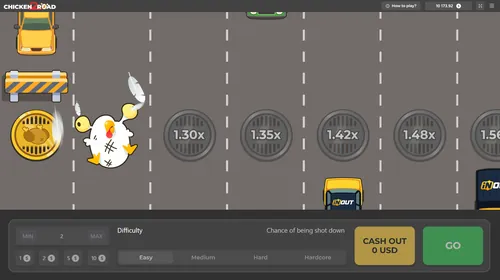
Playing in the mobile browser
Bets start at $0.01 and extend up to $200 per round, providing flexibility for various bankroll sizes when accessing the game via mobile browsers. This wide range allows casual players to test strategies with minimal risk while high rollers can engage with larger stakes comfortably. The platform ensures these limits function identically across different operating systems and browser types without technical restrictions.
A 300% welcome bonus up to €2,000 plus 100 free spins is available for new users registering through mobile devices. This offer provides additional funds to explore the game features, although the free spins typically apply to separate slot titles rather than this crash game. Players must meet wagering requirements before withdrawing any winnings generated from the bonus balance.
Chicken Road differs significantly from its predecessor, Chicken Road, which also operates with an RTP of 98.00 percent but shares the same studio origin. While the earlier title maintains a higher return rate, Chicken Road 2 introduces distinct difficulty levels that alter the risk profile for mobile users. Comparing these metrics helps players choose the variant that aligns with their preferred volatility and expected returns.
Mobile browsers support auto mode functionality, allowing users to preset bet amounts and cash-out targets without constant manual intervention. This feature reduces interaction fatigue during long sessions where maintaining focus on the rising multiplier becomes challenging. Players should configure these settings carefully to avoid unintended losses due to delayed reactions or connection issues.
Screen layout on phones
The interface displays four distinct difficulty levels: Easy, Medium, Hard, and Hardcore, each defining the number of lanes available for movement. Easy mode offers thirty lanes with a maximum multiplier of x23.24, while Hardcore mode restricts play to eighteen lanes but enables wins up to x3,608,855. This structure requires clear visual separation on small screens to prevent confusion between risk tiers.
Medium difficulty provides twenty-five lanes with a potential ceiling of x2,457, striking a balance between frequency and magnitude for average players. Hard difficulty narrows the field to twenty-two lanes, raising the top prize to x62,162 for those willing to accept increased variance. The screen must render these options distinctly so users can quickly identify their chosen path before placing a wager.
Provably fair technology underpins all lane selections, ensuring that outcomes remain transparent and verifiable on mobile devices without compromising speed. This system allows players to independently confirm that the chicken's path was determined randomly before their cash-out decision. Such transparency builds trust in the fairness of the game despite the absence of traditional spinning reels or symbols.
Auto mode settings occupy a dedicated section of the layout, keeping essential controls like bet adjustment and cash-out easily accessible. This placement minimizes accidental taps during critical moments when the multiplier is climbing rapidly toward the crash point. Users can review these settings before starting a round to ensure their parameters match their intended strategy and risk tolerance.
Touch controls and buttons
The primary action involves tapping a button to cash out before the chicken hits an obstacle, a mechanic requiring precise touch response on mobile screens. This simple input method contrasts sharply with slots that demand multiple spins or payline activations, focusing entirely on timing accuracy. Players must develop muscle memory to execute this action reliably under pressure during fast-paced rounds.
Bet adjustment controls allow users to modify stakes within the $0.01 to $200 range using intuitive plus and minus buttons on touch interfaces. These controls update the wager instantly, enabling quick changes between rounds without reloading or navigating away from the main game view. Efficient button placement ensures that financial adjustments do not interfere with the critical cash-out decision process.
Auto mode toggles let players set predefined cash-out multipliers, removing the need for manual intervention during each individual round. This feature supports consistent execution of strategies by handling the timing automatically once triggered by the user. However, relying solely on automation requires careful calibration of targets to account for the inherent volatility of the game.
Comparing Chicken Road 2 to Chicken Road reveals similar control schemes but different risk parameters due to varying lane counts and max wins. Both games utilize straightforward touch interactions, yet the sequel’s Hardcore mode demands faster reflexes due to fewer safe lanes. Understanding these differences helps players adapt their touch responsiveness when switching between difficulty levels or game variants.
Performance on older devices
InOut Games designed Chicken Road 2 to maintain stable performance on older mobile hardware, ensuring smooth rendering of the rising multiplier animation. The game avoids heavy graphical effects that could cause lag on devices with limited processing power or outdated graphics cards. This optimization allows players with legacy smartphones to participate fully without experiencing significant delays or frame drops during critical moments.
The medium volatility setting contributes to predictable pacing, reducing the likelihood of extreme spikes that might overwhelm less capable processors. This balance ensures that the game runs consistently even when background applications consume system resources on aging devices. Players should expect reliable operation provided their device meets basic modern web standards for HTML5 content playback.
With an RTP of 95.50 percent and a max win of x3,608,855, the mathematical model remains efficient regardless of hardware generation. The provably fair algorithm executes quickly, minimizing server latency impacts on slower network connections often associated with older mobile plans. This efficiency ensures that the core gameplay loop remains uninterrupted by technical bottlenecks unrelated to the actual game mechanics.
Chicken Road 2: key facts
| Parameter | Value |
|---|---|
| Game | Chicken Road 2 |
| Studio | InOut Games |
| Released | 2025 |
| RTP | 95.50% |
| House edge | 4.50% |
| Volatility | medium |
| Max win | x3,608,855 |
| Bet range | $0.01 – $200 |
Data use during play
InOut Games structures Chicken Road 2 as a data-intensive crash title where the rising multiplier updates continuously until cash out. The theoretical RTP of 95.50% requires stable transmission to ensure that every calculated return percentage remains accurate across millions of rounds. Mobile players should monitor their connection because packet loss during a high-stakes round can delay the critical confirmation of the cash-out action.
The maximum win potential of x3,608,855 demands significant bandwidth for real-time graphics rendering without any visual stuttering or lag spikes. Players using the Hardcore mode with eighteen lanes experience higher data throughput than those in Easy mode, which uses thirty lanes but lower multipliers. This variance means that network settings must be optimized based on the chosen difficulty level to prevent disconnections during the final seconds of a round.
Bonus terms often include wagering requirements that interact with game participation, so verifying the 300% welcome bonus up to €2,000 conditions is essential before playing. A stable connection ensures that every bet from $0.01 to $200 is recorded correctly by the server without ambiguity or duplication errors. Failure to maintain connectivity may result in lost wagers that do not count toward the required turnover for withdrawing bonus funds.
Playing on unstable connections
Crash games like Chicken Road 2 rely on precise timing for the cash-out decision, making unstable internet connections a significant risk factor for players. InOut Games employs provably fair algorithms that verify each round's outcome, but network interruptions can prevent the player from clicking the button in time. This technical limitation means that even a perfect strategy fails if the device loses signal during the critical moment before the chicken crosses the road.
The medium volatility of this title implies frequent small wins mixed with occasional large payouts, requiring consistent connectivity to track these fluctuations accurately. Players attempting to reach the max win of x3,608,855 must maintain a steady connection throughout the entire session to avoid disqualification from the highest tier. Unstable networks increase the likelihood of missing the cash-out window, effectively turning a potential win into a total loss of the placed stake.
Comparing this to Fish Road, which also features high multipliers but different mechanics, highlights how connection stability affects all instant games equally regardless of theme. The 96.00% RTP of Fish Road does not mitigate the risk of disconnection, proving that network quality is the primary variable for mobile success. Players should prioritize Wi-Fi over cellular data when engaging in long sessions to minimize the chance of abrupt termination during active rounds.
Battery drain in long sessions
Chicken Road 2 utilizes continuous animation loops and real-time multiplier updates, which place a heavy load on mobile device batteries during extended gameplay sessions. The developer InOut Games optimizes the game for efficiency, but the medium volatility nature still requires constant processing power to render the rising curve smoothly. Players should expect faster battery depletion when playing in Hardcore mode due to the higher frequency of rapid visual changes and calculations.
The bet range of $0.01 to $200 allows for flexible session lengths, but high-frequency betting drains power more quickly than low-frequency strategies. Each round involves complex mathematical computations to determine the crash point, which consumes CPU resources significantly more than static slot games. Managing background applications is crucial for maintaining performance, especially when attempting to achieve the theoretical return of 95.50% over hundreds of thousands of rounds.
Auto mode offers a slight reduction in battery consumption by automating the cash-out process, reducing the need for constant user interaction and screen polling. However, the graphical intensity of the forty-eight lanes across all difficulty levels remains a major factor in energy usage regardless of input method. Players planning to chase the maximum win of x3,608,855 should keep their devices plugged in to avoid unexpected shutdowns during critical moments.
Portrait and landscape modes
Chicken Road 2 supports both portrait and landscape orientations, allowing players to choose the view that best fits their mobile device and thumb reach. The layout adjusts dynamically to display the forty-eight lanes clearly, ensuring that the rising multiplier path remains visible without excessive scrolling or zooming. InOut Games prioritizes usability by keeping the cash-out button prominently positioned in both modes, reducing the risk of accidental taps during high-pressure situations.
Landscape mode provides a wider field of view, which is beneficial for tracking the progression through the thirty lanes of the Easy difficulty level. Portrait mode concentrates the interface elements vertically, offering a more compact design that fits comfortably in one-handed play scenarios for quick decisions. The choice between orientations does not affect the mathematical edge, as the house edge of 4.50% remains constant regardless of the screen configuration used.
Fish Road similarly adapts to different screen sizes, but its distinct mechanics require different spatial arrangements compared to the lane-based structure of Chicken Road 2. The 96.00% RTP of Fish Road operates independently of the orientation choice, confirming that visual presentation does not influence the underlying game mathematics. Players should test both modes to determine which provides the most comfortable experience for executing timely cash-outs during volatile rounds.
Sound and animation settings
InOut Games includes customizable sound and animation settings to accommodate different player preferences and environmental constraints during mobile gaming sessions. Disabling animations can reduce visual clutter and improve performance on older devices, while keeping sounds on enhances the feedback for successful cash-outs. The medium volatility of the game ensures that audio cues remain relevant even when visual effects are minimized, helping players stay engaged with the rising multiplier.
The theoretical RTP of 95.50% is unaffected by aesthetic choices, meaning that players can optimize their device settings for performance without altering the expected return. High-quality animations consume more resources, so disabling them may help maintain a stable frame rate during intense rounds approaching the maximum win of x3,608,855. Players should experiment with these settings to find the balance between immersion and technical efficiency that suits their specific hardware capabilities.
Compared to Fish Road, which relies heavily on thematic audio to enhance its underwater narrative, Chicken Road 2 focuses on functional sound design for clarity. The 96.00% RTP of Fish Road does not depend on its auditory features, just as Chicken Road 2's provably fair system works independently of sound settings. Users can mute all effects completely without impacting the accuracy of the cash-out mechanism or the integrity of the random number generation process.
Phone versus desktop play
The maximum win cap for Chicken Road 2 is set at x3,608,855, which defines the theoretical upper limit of a single rising multiplier round. This figure represents the potential payout for a successful cash out before the crash event concludes on any difficulty level. Players utilizing a smartphone interface must monitor this ceiling closely as the multiplier climbs rapidly during gameplay.
InOut Games released this title in 2025 with a fixed bet range spanning from $0.01 to $200 per round. The interface adapts these limits seamlessly across devices, ensuring that high rollers can maintain their standard wagering parameters on mobile screens. Desktop users typically benefit from a larger visual field for tracking the chicken's progress across the lanes.
Rabbit Road by InOut Games shares an identical maximum win cap of x3,608,855, highlighting the studio's consistent risk architecture. Comparing the two titles reveals that mobile play does not dilute the potential reward structure of the original design. The core mechanic remains unchanged regardless of the screen size or input method used.
Tablet experience
Chicken Road 2 features four distinct difficulty levels, including Hardcore mode which offers up to 18 lanes and a potential multiplier of x3,608,855. Tablet screens provide an optimal balance between the compact view of phones and the expansive layout of desktop monitors. This resolution allows players to clearly distinguish the increasing multipliers without zooming or straining their eyes.
The game operates with a volatility classified as medium, influencing the frequency and size of payouts during a session. A theoretical RTP of 95.50% ensures a house edge of 4.50% over extended play periods. Tablets handle the real-time rendering of the crash mechanics smoothly, maintaining synchronization with the server-side calculations.
Auto mode functionality is fully accessible on tablet devices, allowing players to set predefined cash-out points for each round. This feature streamlines the process of managing bets within the $0.01 to $200 range without constant manual intervention. The tactile interface of tablets also facilitates quick taps required for manual cash-outs when reacting to fast-moving multipliers.
What changes on a small screen
The Easy difficulty level presents 30 lanes with a maximum multiplier potential of x23.24, making it highly suitable for smaller phone displays. The reduced lane count in Hard (22 lanes) and Hardcore (18 lanes) modes requires sharper focus on a limited visual area. Players must rely on the provably fair algorithm rather than visual cues to determine safe cash-out timing.
Mobile interfaces often simplify the display of complex statistical data compared to desktop versions of instant games. While Chicken Road 2 retains its core mathematical integrity, the presentation of the 95.50% RTP is condensed into accessible menus. Users should verify their settings to ensure the auto-mode parameters are correctly configured before starting a session.
Comparison with Rabbit Road indicates that both titles utilize similar responsive design principles for their lane-based mechanics. The transition from a large desktop monitor to a mobile device primarily affects the density of information displayed per square inch. Strategic adjustments in betting speed may be necessary to accommodate the faster tap response times typical of touchscreens.
Interrupted rounds and reconnects
Chicken Road 2 utilizes a provably fair system to guarantee the integrity of each rising multiplier round. If a mobile connection drops during a round, the server maintains the state of the game until the crash occurs. Upon reconnection, the player receives the result based on whether they had successfully initiated a cash-out command before the end.
The technical infrastructure supports stable connections even when network latency fluctuates on cellular data networks. Since the game has no reels or spins, the outcome is determined instantly by a cryptographic seed upon the crash event. Players should note that failure to cash out manually or via auto-mode results in the loss of the placed bet.
InOut Games designed the backend to handle interruptions gracefully, minimizing the risk of disputed outcomes. Unlike traditional slot machines, there are no spinning animations that might mask a lost connection. The transparency of the crash point allows users to verify results independently using the provably fair tools provided in the interface.
Mobile demo mode
A free demo version of Chicken Road 2 is available for testing on mobile devices without requiring real money deposits. This mode replicates the exact mechanics of the paid game, including the four difficulty levels and the x3,608,855 max win potential. Players can practice cashing out strategies using virtual credits to understand the volatility of the medium-risk setting.
The demo mode restricts access to the full $0.01 to $200 bet range, typically capping wagers at a lower nominal value. This limitation prevents the accumulation of significant virtual balances while still demonstrating the mathematical behavior of the 95.50% RTP. Users can switch between Easy and Hardcore modes to observe how lane counts affect the pace of multiplier growth.
Comparing the demo experience to live play reveals no differences in the underlying random number generation algorithms. The only distinction lies in the currency used for betting and the absence of real financial risk. This feature allows new players to familiarize themselves with the unique step-based road-crossing mechanic before committing funds.
DemoRTP & VolatilityHow to PlayAuto CashoutStrategyBonusesMobileDownload & AppMax WinSimilar GamesReviewFAQSitemap
Chicken road 2 2026